


Vertigo is not pleasant. At some point during the aging process my discomfort with heights developed into vertigo. Whilst unpleasant and irritating it has been something that I have managed by avoidance.
What has this got to do with running you may ask. Other than researching events and trails carefully and avoiding skylines and precipitous trails it has had little impact. However, this all changed in the middle of November.
The gentle breeze that was beginning to guide me out of the doldrums of the last two years was showing progress. My revised training programme combined with being kind to myself was beginning to reap rewards. I was starting to enjoy training again, feeling positive effects from the changes and had begun to extend my weekend runs with a view to reinstating long runs. I had even started to look for new challenges for 2026.
Then one Saturday evening, a seasick inducing swell caught my ship. As I stood up from the sofa a wave of dizziness hit. Odd, I thought, as I dismissed it and headed to bed only to feel the bed, or was it the room, vaguely spinning. I convinced myself it was just tiredness and that everything would be fine after a good night’s sleep. How wrong I was.

Morning arrived along with nausea, a headache and significant dizziness. It was like permanent seasickness or constant vertigo induced by looking down from the top of a cliff. Eventually, I resorted to calling NHS24 who sent me to the out of hours GP clinic. Luckily, it is close by because I could not begin to contemplate getting into a car. I was able to walk slowly with no head turning and fixing my gaze straight and on the middle distance.
I was assuming an inner ear infection, but it was diagnosed as Labyrinthitis, an inflammation in the ear causing the ‘crystals’ (canaliths) in the inner ear to move out of place. It can be caused by infection, bacterial or viral, and can be exacerbated by stress and tiredness. The GP found no obvious signs of infection. I was given medication to deal with the symptoms and a set on exercises to be done three times a day which would encourage the canaliths to return to their normal position.
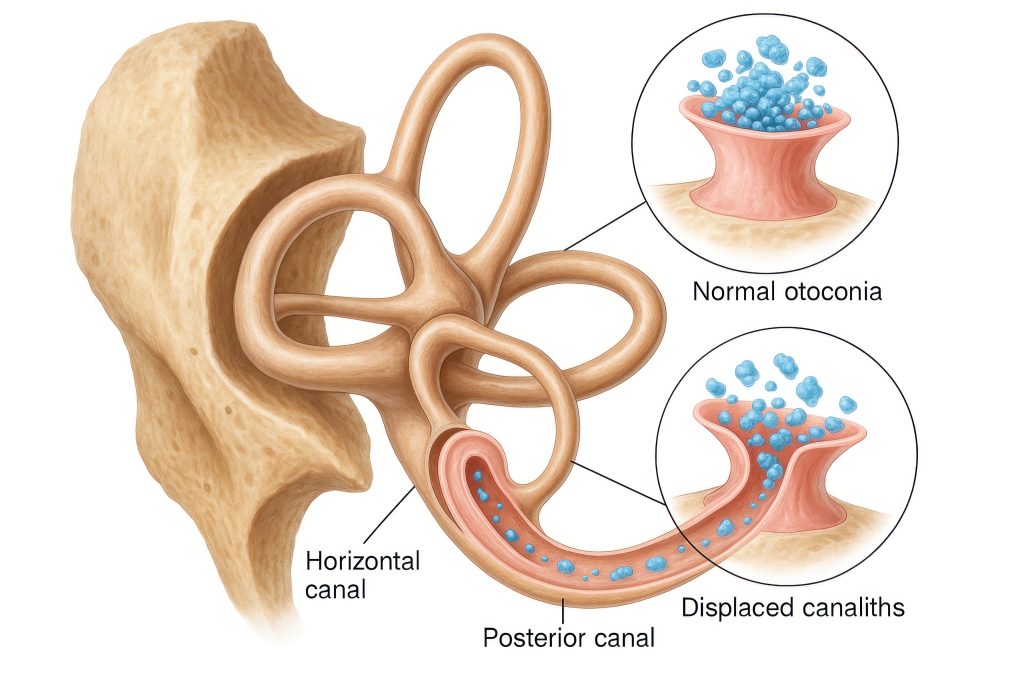
Over the next five days things improved. The nausea departed and the dizziness began to recede. The following week I trialled a gentle return to training. It all seemed OK. Then out of the blue it hit again just a badly as the first time with tinnitus thrown in for good measure. Back on the medication it once again receded, but has not completely gone. I am still experiencing periodic low-level symptoms and mild tinnitus which just seem to appear from nowhere.
That said, I have learned to pick-up on signs. A particular type of headache or tinnitus will herald a return. Rapid movement of things coming towards me or on my peripheral vision seem to trigger it. Certain movements too: bending for too long or twisting and turning too frequently or too quickly. I think that I have a low level virus in my sinuses also, which could be the root cause of the Labyrinthitis.
Circumstances have almost certainly slowed my recovery. Work has been extremely busy and stressful, and I haven’t been able to take time off. I feel mentally and physically exhausted, and I can’t do the one thing that helps manage my well-being: running.
The last time I was in a car was mid-November. I have no drive either mental or physical to attempt any sort of training other than walking. which has to be local because of the issue with the car. My assumption is that the lack of desire is my body telling me it is not ready, and so, I am listening to it.
It is just so debilitating and I don’t even have the energy to get angry or frustrated with it. I seem to just be simply existing, functioning at a glacial pace in a brain fog.
It will clear. I know people who have suffered it and they all say that it will eventually go, but in its own good time. This is clearly an ultra of different kind that I am going to have to navigate my way through with grit and determination and at a pace determined by the labyrinthine terrain.
For anyone wondering whether you can run with Labyrinthitis, my experience suggests caution. While symptoms can improve quickly, returning to training too early can trigger setbacks, especially when stress and fatigue are involved.